

Leonardo: the Man with One Question
Da Vinci asked: What are the principles that govern the behavior of the world? The things we’ve since carved up into separate academic departments, Leonardo experienced as a single inquiry.

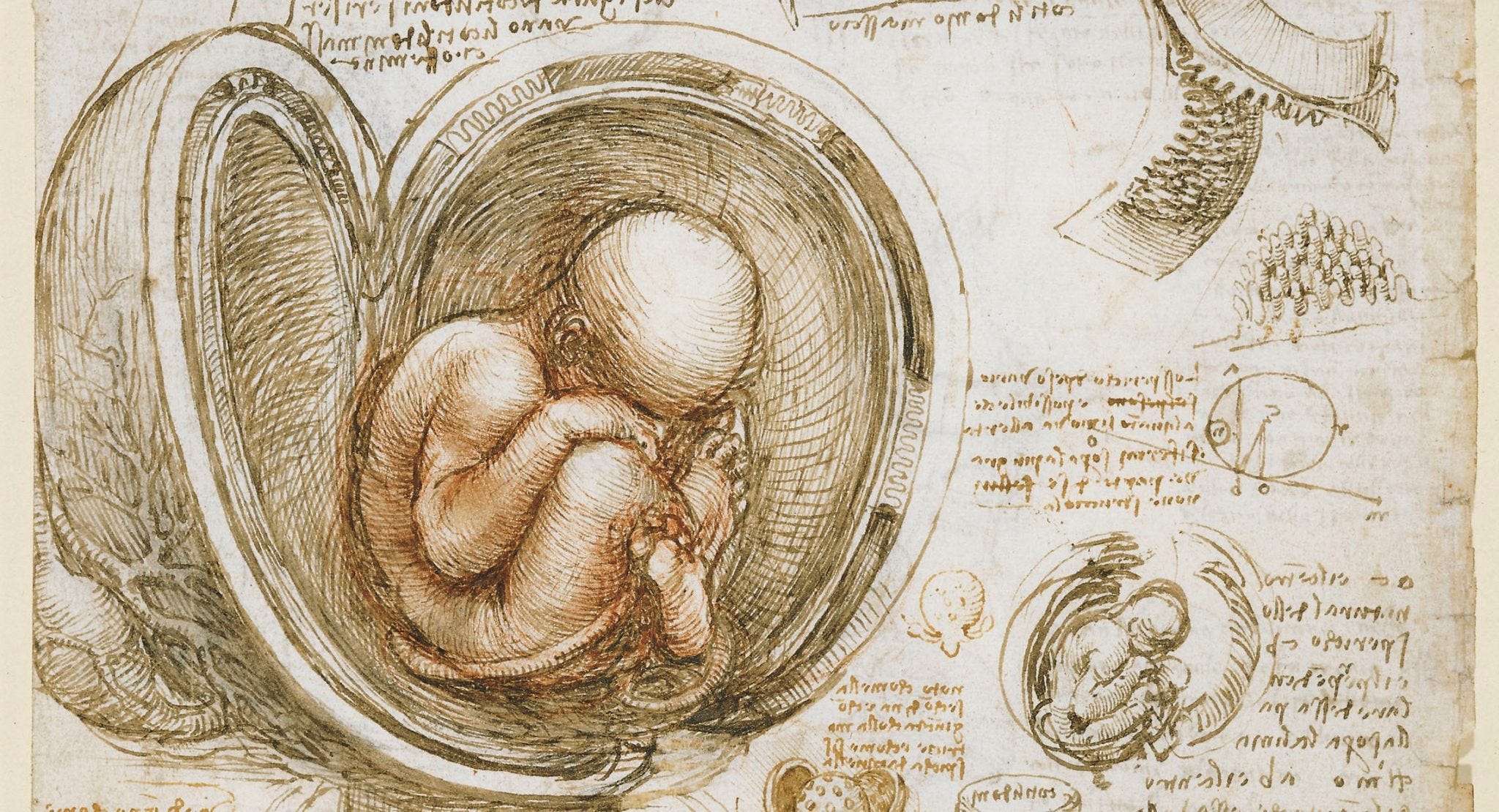
Dear CCR Reader,
I keep a postcard on my desk of Leonardo da Vinci’s drawing of the baby in the womb. You’ve probably seen it: the curled infant suspended within a cross-sectioned uterus, encircled by Leonardo’s characteristic mirror-script notes, and framed again by smaller anatomical sketches and geometric studies. (See image above.) It is one of the most beautiful things ever rendered by the hand of man. It is also, in a limited sense, a scientific diagram.
But “a scientific diagram” is precisely the sort of phrase that would have drawn from Leonardo only a puzzled look.
Last week I suggested that the Wunderkammer was not only a cabinet of curiosities but a philosophy, that the Renaissance collector who placed a nautilus shell beside a Roman coin beside an anatomical sketch was making a claim about the coherence of the world. Earlier this week, I described the commonplace book as the paper analogue of that same practice: a place where Aristotle and Augustine and even a twenty-first-century neuroscientist might find themselves in the same room, in conversation, because you have gathered them there. Both letters were circling the same conviction—that the disciplines belong together, that their connections are real, and that the person who traces those connections is thinking more clearly than the specialist who refuses them.
This week, I want to show what that conviction looks like when it is fully inhabited. I want to talk about Leonardo da Vinci.
We have been misreading him for five hundred years, and the misreading tells us more about us than it does about him.
